Newton Studies Oklahoma's Water Resources
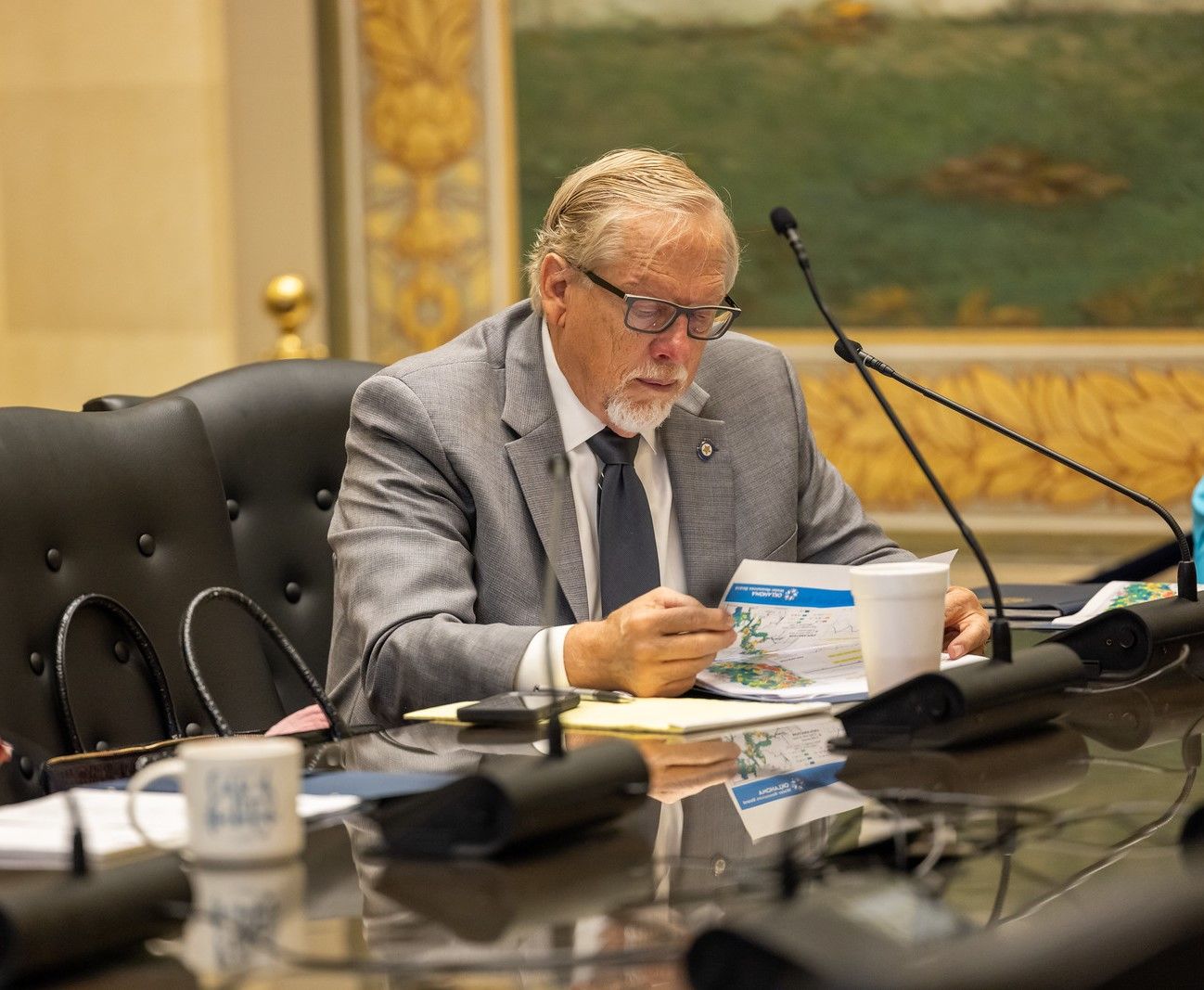
OKLAHOMA CITY – Rep. Carl Newton, R-Cherokee, on Tuesday held an interim study before the House Agriculture Committee examining Oklahoma’s existing water resources, current management practices and long-term sustainability efforts.
"There's probably not anything else that's more crucial to our everyday life than water," Newton said. "You can live without food longer than you can live without water. And so, in Northwest Oklahoma or a lot of Western Oklahoma, we depend on underground waters. We don't have these nice, huge lakes that some of them have in Eastern Oklahoma. And so, without that underground water, we would cease to exist out there. And so with that, this is just to get an idea of where we're at on our underground water. Are there any solutions to this? Or is there anything we can do to help prevent further loss of that water?"
Newton said water conservation and use has been on his heart for years, but the current drought is bringing additional urgency to the issue.
"I know some of the other representatives in my area are getting hit up by people that their aquifers have dropped and their wells are dry," he said. "And so, with that a factor, people are very concerned about that."
Newton invited Christoper R. Neel, Chief of the Water Rights Administration Division at the Oklahoma Water Resources Board, to discuss groundwater and well-permitting law.
Neel displayed the severity of drought in Western Oklahoma and the Panhandle, which experience the worst drought classifications up to 30% of the time. The overlap of groundwater permits in the state shows the heaviest concentration in the same area.
One issue is that groundwater wells were not required to be reported to the Water Resources Board until 1982, and the board has only about 50% compliance. In addition, most permit holders just estimate how much water they use each year. And the board is not an enforcement agency, so landowners are basically on the honor system, even though each is supposed to get an equal proportionate share of available water.
"So, you combine the number of wells that are being drilled in Oklahoma with drought with the amount of permits that we have. You can kind of understand why we're sitting here and talking about groundwater just to give an update of what the state of Oklahoma is up to," he said.
Duane Smith, executive director, and Josh McClintock, water policy specialist, with the Oka' Water Institute at East Central University, explained watershed sustainability.
Smith explained that reduced water supply associated with drought and a warmer drier climate endangers public health, threatens habitat and jeopardizes local and state economies. He said funding statewide drinking water infrastructure needs by 2045 will total $117.6 billion. It's imperative that regions throughout the state begin planning to fund and meet these needs, he said, to mitigate depletion and to conserve this resource.
Tom Kimball, a Board of Directors member with the Grand River Dam Authority, examined alternative help for declining aquifers, including the possibility of water transfer.
"Water transfer is a big project," Kimball said. "If you come from western Oklahoma and say we're going to put a pipe in Grand Lake and start pumping water west, well, you're going to hear a lot of people probably start hollering. So, it's very difficult to go in and say we're going to take water from here and take it to there, even if you don't need it where it's at. But it's not difficult to take the water away from the people in New Orleans, Louisiana."
Kimball explained that when the GRDA generates electricity at the Pensacola Dam at Grand Lake, the water goes into Lake Hudson, Lake Fort Gibson and then the Arkansas and Mississippi rivers, ending in the Gulf of Mexico.
"It's not used for navigation. It's not used for irrigation," Kimball said. "It's not used as potable water. Once it goes through generation, it's going to New Orleans and used for absolutely nothing."
The water could instead be captured and moved west, a difficult but not impossible task, he said. This could happen from other areas of the state as well, he said. He begged study participants to make sure water is not secured by private industry but instead remains available for future generations of Oklahomans.
"With our water moving around the state where it's needed, we can produce jobs for our children and grandchildren that are just not even really thought of today," Kimball said.
It's something to dream about, Newton said.
The study can be watched on the House website under News & Media, live proceedings, then search by date for Sept. 8, IS26-006 Oklahoma Water Resources.
