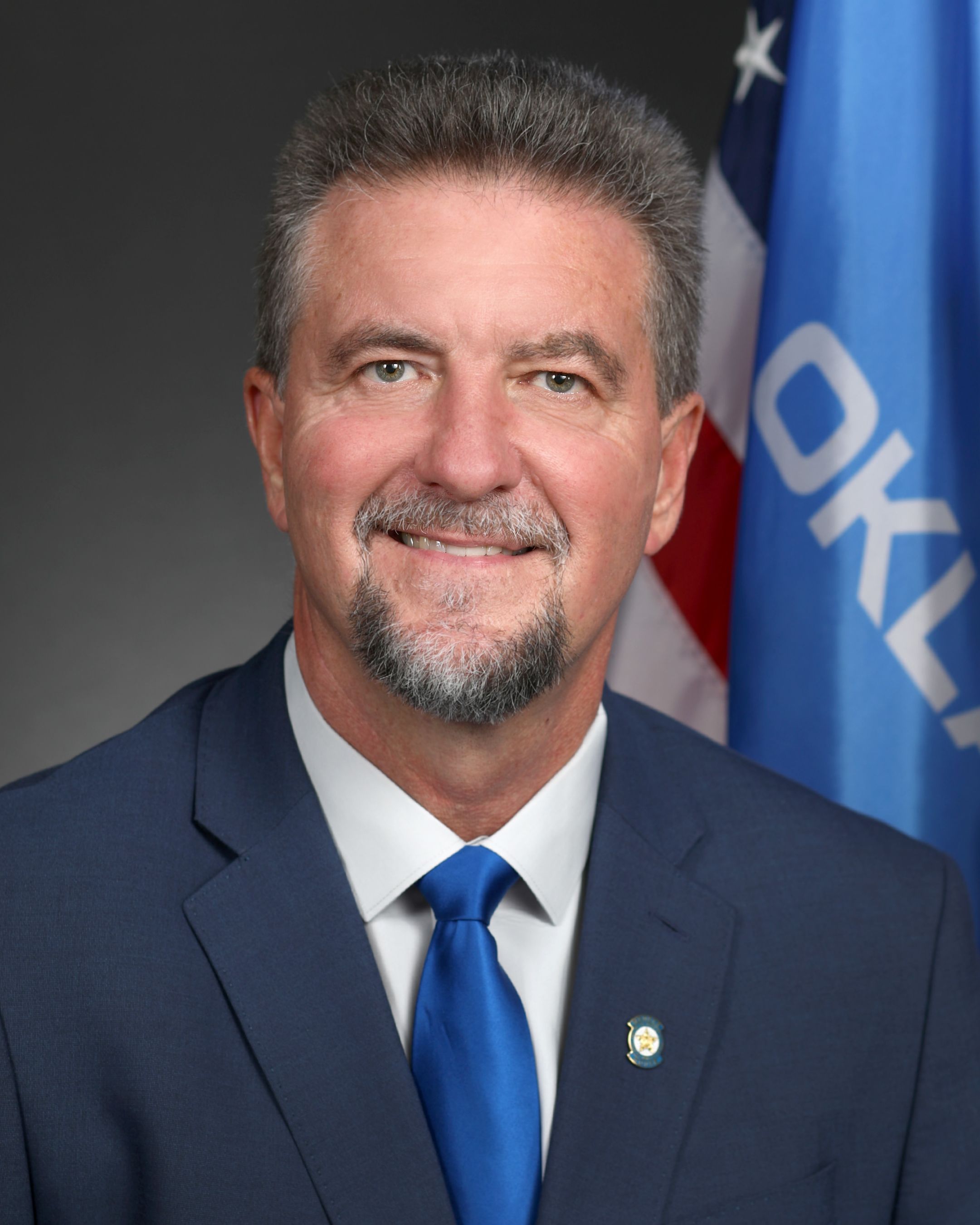
Representative Mike Dobrinski

Hi, I'm Mike Dobrinski and I represent the people of Oklahoma's 59th District.


representative

Leadership

Assistant Majority Whip

59th Legislature

News & Announcements


Feb 20, 2026
Recent Posts

Dobrinski Urges Governor, Legislature to Fund Wildfire Reduction Effort

OKLAHOMA CITY - Rep. Mike Dobrinski, R-Okeene, today urged action by the governor in concert with the Legislature to expand funding for eradicating invasive species as the state faces early wildfires. Dobrinski is the author of legislation that created the Terry Peach North Canadian Watershed Restoration Act and the House author of legislation that requires the Oklahoma Conservation Commission to implement a statewide plan targeting harmful woody species on state lands. Both are efforts to reduce materials that consume massive amounts of water and lead to fire threats. This year, Dobrinski is running House Bill 2988 , which currently recommends a tax credit for those who remove harmful woody species through qualified practices as defined by the Conservation Commission. The bill passed in the Appropriations and Budget Natural Resources Subcommittee. Dobrinski said the legislation will be amended before it reaches the House full A&B Committee to instead expand the Terry Peach Act.  "February is not traditionally a month we consider a wildfire risk," Dobrinski said. "After record snowfall last month, warm temperatures and winds have created threatening conditions earlier than usual. Woodward was spared this week, by the grace of God and the work of hundreds of firefighters and first responders. Many in the Panhandle and Northwest Oklahoma, however, have suffered great loss." Dobrinski said lawmakers have talked for years about eastern red cedars and their challenge to the western Oklahoma water supply, along with the fire threat they present for much of the state. "This issue predates my service at the Capitol by at least two decades," he said. "The Terry Peach North Canadian Watershed Restoration Act was a trial study that proved that addressing this issue would improve waterflow, restore native grasslands, return ecological balance and promote wildlife habitat."   Dobrinski said Woodward was threatened because of the proliferation of eastern red cedars southwest of the city, very much like the communities of Stillwater and Mannford, which suffered wildfires last spring. "Our own governor lost a rural residence northeast of the Oklahoma City metro area in those fires, in an area that is very thick with eastern red cedars on neighboring properties," Dobrinski said.  "As the governor approaches the end of his administration, we can celebrate many victories and improvements to our wonderful state," Dobrinski said. "I encourage him to include in his legacy being the governor that decided it was time to turn the tide on our ever increasing eastern red cedar problem. I ask him to please work with our Legislature and emphasize the need to properly fund a sustained effort to improve our state's land and water resources and ensure a safer future for generations to come." 


Oct 21, 2025
Recent Posts

Lawmakers Study State Emergency Communications Systems

OKLAHOMA CITY – A study examining a statewide emergency communications system was held before the House Appropriations & Budget Public Safety Subcommittee last week. Rep. Ross Ford, R-Broken Arrow, who chairs the committee and is a former longtime police officer, led the discussion. "Those of us in law enforcement have been hearing since the 1980s that we are just around the corner from getting a statewide radio system," Ford said. "Here, it's now 40 some years later, and we are no closer to getting a statewide radio system than we were in 1981." Ford's hope is to find ways to fund a system that would reach all parts of the state. Mike Dobrinski, R-Okeene, said he wanted to ensure the rural county perspective was represented in the study. "As great as having a statewide system sounds, we obviously have a lot of areas of this state that can't even talk to each other, let alone statewide," he said.  Dobrinski represents five rural counties and said with the exception of a few larger cities, most emergency operators are frustrated and scared because they can't talk to each other during wildfires, severe weather events or other emergencies. He asked Justin Carnagey, 911 director for the Texas County 911 Trust Authority in the center of the Oklahoma Panhandle, to discuss how he has been able to access funding to upgrade their radio system to better communicate in the county and with surrounding areas. Carnagey said they secured American Rescue Plan Act (ARPA) and other grant funding as well as a dedicated county tax to purchase new radios, a new tower and additional systems to support the county's fire, law enforcement and emergency services.  They recently helped Cimarron County get a grant for one channel on a new radio system. That has been a gamechanger for first responders in that county that had no radio communication and very limited cellphone coverage. Pricing is the biggest hurdle for rural counties, Carnagey said. He also said any statewide system that's deployed will have to accommodate interoperability between rural and metro areas as well as state agencies.  "When we talk about governance of this system, it's key that we have representation from everybody involved," he said. His county trust worked with ODOT, the Department of Public Safety and even Homeland Security to save money on the system they now have, he said.  Ford said if this can be done in the Panhandle, surely this can be duplicated throughout the state, especially in the more rural areas. He invited Mark Ketchum, director of communications for Wagoner County and a former communications engineer for the City of Broken Arrow, to speak about the system he helped build in Broken Arrow and surrounding communities. Ketchum said he worked to build partnerships between multiple agencies from law enforcement, fire, emergency management services (EMS), public schools, hospitals, military and others to bring them into the same network. That was back when technology was proprietary. Now, P25 radios work together, regardless of vendors, with the proper programming. "I did this to show people in Oklahoma that you can communicate across systems," Ketchum said. "You can build partnerships, but infrastructure is the key. In a crisis situation, you have to be able to talk to each other." Bobby Howard, Acting Public Safety Commissioner with the Muscogee (Creek) Nation, gave a perspective from tribal nations. He spoke about partnering with Okfuskee County, building infrastructure and bringing various departments into their network at no cost other than the purchase of radios. This was to assist all law enforcement officers and other first responders who were responding jointly to emergency calls. "You have to have people that want to work together," Howard said. There are some counties and departments that don't want to talk with the tribe until they have a problem. Then they want to patch in to talk to his S.W.A.T., drone or other special teams within the nation. "I think a statewide system would force their hand to talk," Howard said.  Taylor Henderson, assistant director of operations with the Oklahoma Department of Transportation (ODOT), spoke of the department's work with various government and non-governmental organizations, beginning in 2022, to create an interoperable statewide radio strategic plan that would cover as much as 93% of the state. He said one challenge is many of the systems are approaching their use expectancy limits. Many of the towers were built in the 1960s and need to be completely replaced.  "We're just trying to keep it together with bailing wire and Band-Aids," Henderson said.  The price estimated in 2022 for creating and maintaining a system that would include 190 towers, was about $600 million over the lifetime of the buildout. With inflation, it would likely cost as much as 60% more now. Ford said he will request additional funding from the Legislature to help ODOT replace deficient radio towers throughout the state. He also suggested pursuing reciprocity agreements with surrounding states to use their radio towers when possible. ODOT does allow other entities to share their towers. They also make use of microwave and fiber optics. Lauren Kirkland, vice president of Motorola Solutions, spoke of how the company has a dedicated Oklahoma emergency response team that has equipped many state first responders with radios and technology  "Interoperability is the backbone of public safety communications," she said. "It allows emergency responders from different agencies, jurisdictions and disciplines to effectively communicate and coordinate during incidents whether it's a natural disaster like a tornado, a public health emergency or large-scale security events. Interoperability communications save lives." Mike Miller, an owner of Eastern Communication LTD with headquarters in New York City, Iowa and Washington state, suggested his company – an integrator of technologies and not a manufacturer – might be able to help the state plan for better interoperability between manufacturers of different systems. He said interoperability for emergency communication systems is possible, just like cellphone coverage between various carriers can be seamless. But states have to get beyond the first step of just buying radios. Infrastructure and continual upgrade plans to support the technology that connects all radios and systems, regardless of the manufacturer, also have to be factored. States need to pan 50% of cost for equipment and 50% to maintain the system. He mentioned hacking by hostile nations into water treatment plants and power systems has happened because of outdated equipment or the failure to patch with software updates.


Oct 1, 2025
Recent Posts

Speaker Hilbert and House Members Host Capitol to Community Event in Woodward

House Speaker Kyle Hilbert, R-Bristow, and members of the Oklahoma House Republican Caucus continued their statewide Capitol to Community series this week with a two-day stop in Woodward. The event highlighted the region’s strengths in education, youth services, energy and natural resources while giving lawmakers the chance to engage directly with local leaders and residents. The tour began Sunday evening with a community reception at the Woodward County Event Center. On Monday, members spent a full day immersed in the area. Highlights included a visit to the Woodward TAP (Technical Applications Program) at Woodward Middle School, a stop at Western Plains Youth & Family Services to learn more about local efforts to support children and families and a tour of the High Plains Technology Center. The afternoon included a guided bus tour through Alabaster Caverns State Park, Boiling Springs State Park, and the Terry Peach Watershed Restoration Expansion Project, which gave legislators a firsthand look at the region’s natural resources and conservation efforts. “From career training in our schools to the stewardship of our natural resources, this community shows how local initiative and state partnership can come together to create real opportunities," said Speaker Hilbert. "Our Capitol to Community tour is about learning from local voices, and Woodward reminded us just how much Oklahoma’s strength begins at the community level." Representatives Mike Dobrinski, R-Okeene, and Carl Newton, R-Cherokee, who both represent the Woodward area, praised the event as an important opportunity to showcase northwest Oklahoma’s contributions to the state: “Northwest Oklahoma is proud of its people, its land, and its industries. This tour gave us the chance to highlight that on a larger stage. From education to energy to natural resources, Woodward plays a vital role in Oklahoma’s success. Having Speaker Hilbert and our colleagues here to see it firsthand is invaluable, and we are grateful for their commitment to listening and engaging directly with our communities.” The Capitol to Community series will continue with additional stops across Oklahoma throughout the interim including Ardmore, Lawton and Guthrie.