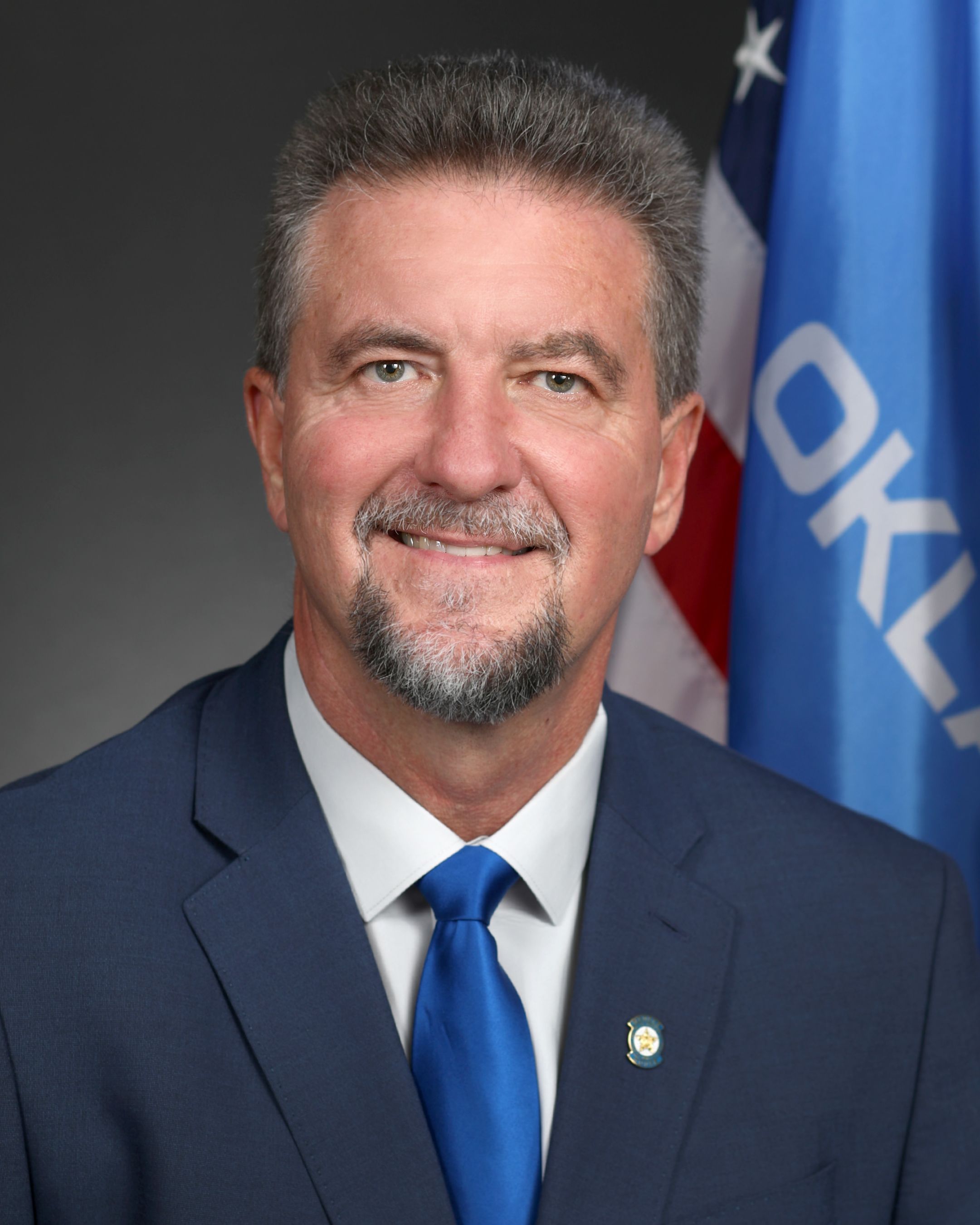
Representative Mike Dobrinski

Hi, I'm Mike Dobrinski and I represent the people of Oklahoma's 59th District.


representative

Leadership

Assistant Majority Whip

59th Legislature

News & Announcements


Jun 1, 2026
Recent Posts

Dobrinski Comments on Pocket Veto of Bill Prohibiting Solar, Battery Tax Exemptions

OKLAHOMA CITY – Rep. Mike Dobrinski, R-Okeene, commented today on the governor's pocket veto of legislation that would have prohibited solar generation facilities and battery energy storage systems (BESS) from qualifying for the Five-Year Ad Valorem Exemption for Manufacturers, beginning in January 2028. Dobrinski is chairman of the House Utilities Committee and House author of Senate Bill 237 . The governor had until midnight May 29 to take action on the bill. Because he did not sign it into law, and because the 2026 legislative session is adjourned sine die, the bill became pocket vetoed.  "I'm extremely disappointed the governor chose not to enact this legislation that had widespread support from constituents and legislators alike," Dobrinski said. "He overruled the decision of more than 100 representatives and senators to protect taxpayer money from going to out-of-state developers taking advantage of a forty-year-old tax incentive originally designed to add quality jobs investment to our state. I represent thousands of constituents involved with the energy industry, both petroleum and renewables. Landowners choose whether they participate in various energy projects based on their own operations and unique family situation. What most agree on, however, is they support President Trump's decision to put an end to federal subsidization of the renewable industry, and Oklahoma should do the same!"   Dobrinski explained the five-year exemption was eliminated for wind in 2015 with Senate Bill 498 . In 2021, the Legislature recognized data centers were costing the state $46 million annually through the exemption, so that eligibility was removed with Senate Bill 609 .  "Eliminating this tax exemption for wind and data centers has obviously not deterred those types of new development projects in Oklahoma," Dobrinski emphasized. "We are talking about hundreds of millions of dollars over the next several years that could go toward much-needed projects and services for hard-working Oklahomans. I look forward to working soon with our next governor to end this corporate welfare as quickly as possible."


May 21, 2026
Recent Posts

Strom's Eight-Bill Package Addressing Government Spending Oversight Signed into Law

OKLAHOMA CITY – A bipartisan package of eight bills authored by Rep. Judd Strom, R-Copan, that will increase transparency in public contracts and prevent misuse of taxpayer dollars has been signed into law. The legislative package of bills was developed following concerns about gaps in government spending oversight and after an audit by State Auditor & Inspector Cindy Byrd identified $93.4 million in misspent expenditures. Strom, who serves as the Chairman of the House General Government Appropriations and Budget Committee, worked alongside lawmakers from both parties during the 2025 interim to identify ways to prevent similar issues from happening again. Other lawmakers included Rep. Gerrid Kendrix, R-Altus; Rep. Denise Crosswhite-Hader, R-Piedmont; Rep. Mike Dobrinski, R-Okeene; Rep. Preston Stinson, R-Edmond; and Rep. Andy Fugate, D-Oklahoma City. "I brought in lawmakers and from all over the State and political spectrum to work on this project. We all agreed that the people we serve deserve to be confident in the idea that their investment in this State is being handled responsibly," Strom said. "This was a heavy lift, but I appreciate the long hours and hard work that each member put in. I also appreciate the time and effort that the Auditor and her staff lent to us. We went back over years of documented waste, fraud, and abuse of taxpayer dollars and asked, ‘What would have prevented this? What can we put in place to make sure this never happens again?" Governor Kevin Stitt signed all eight bills into law and said transparency is important to Oklahomans. "As governor, I have fought for transparency and accountability for Oklahoma taxpayers. The transparency laws passed this session further that goal," Stitt said. "Government works for the people, not the other way around, and these reforms help preserve the trust Oklahomans have in their state and local institutions." The legislation focuses on increasing transparency in state contracting, adding more safeguards to the procurement process, improving documentation requirements and helping prevent conflicts of interest and misuse of public funds. "Too often, lawmakers and taxpayers are left finding out after the fact that millions of dollars were mishandled or poorly tracked," Strom said. "These new laws put stronger safeguards in place on the front end so contract details are easier to access, and the public can better see where their money is going." The package also includes reforms related to government bidding practices. Lawmakers said the measures are intended to create a more transparent and competitive process while discouraging favoritism and poor-quality contracting. "This legislation helps eliminate the good-old-boy system by creating fairness in contracting," Strom said. "The honest contractors doing things the right way should not have to compete against bad actors benefiting from weak oversight." The new laws included in the package are: House Bill 3413 by Strom and Sen. Tom Woods, R-Westville, expands transparency in state agency contracting by requiring agencies to publicly list contractors, contract values and project status while disclosing consultant reports and staffing-related contracts. House Bill 3414 by Strom and Sen. Bill Coleman, R-Ponca City, directs the Office of Management and Enterprise Services to improve accounting systems related to service contracts, staff augmentation and documentation for digital and intangible assets. House Bill 3415 by Strom and Sen. Julie Daniels, R-Bartlesville, requires vendors to disclose subcontractors, tightens documentation standards, mandates post-project reviews and creates a public database of state contracts. House Bill 3418 also by Strom and Daniels updates the Public Competitive Bidding Act to refine procedures for public construction projects and ensure more consistent bidding practices, and criminalizes violations of the Central Purchasing Act. This law will take effect Nov. 1, 2027. House Bill 3416 by Strom and Sen. Jerry Alvord, R-Wilson, allows counties to seek quotes for certain smaller purchases while maintaining documentation and oversight safeguards. House Bill 3417 also by Strom and Alvord authorizes certain political subdivisions and public trusts to use real-time reverse auction bidding procedures for goods and services purchases. House Bill 3419 by Strom and Sen. Jack Stewart, R-Yukon, tightens ethics laws by making it a felony for officials, employees or contractors to use confidential government information for personal financial gain. House Bill 3420 by Strom and Sen. Carrie Hicks, D-Oklahoma City, tightens oversight requirements for negotiated contracts and requires additional public reporting of procurement activity. All measures take effect Nov. 1, except for HB3418, which takes effect Nov. 1, 2027.


May 5, 2026
Recent Posts

Dobrinski Passes Bill Prohibiting Solar, Battery Tax Exemptions

OKLAHOMA CITY – The House on Monday passed a bill that would prohibit solar generation facilities and battery energy storage systems (BESS) from qualifying for the five-year manufacturer ad valorem tax exemption beginning in January 2028. Rep. Mike Dobrinski, R-Okeene, is the House author of Senate Bill 237 . "Huge international energy developers do not need to be subsidized by Oklahoma tax dollars," Dobrinski said. "Oklahoma has 30 more days of sunshine than the average U.S. state. Our land prices, even with recent significant hikes, are still some of the lowest in the nation. We've removed similar exemptions for wind energy and data centers. It's past time for Oklahoma to treat solar and battery storage the same." Dobrinski explained this tax exemption was eliminated for wind in 2015 with Senate Bill 498 . In 2021, the Legislature recognized data centers were costing the state $46 million annually through the exemption, he said. Their eligibility was removed with Senate Bill 609 . "As lawmakers, we have the authority to add or remove categories of qualifying manufacturers through statute when these exemptions are no longer needed to promote investment in various industries," he said.  Dobrinski said most in the state embrace an all-of the-above approach to energy, and the state enjoys some of the lowest costs for power because of it. "Oklahoma is a net exporter of energy because of our abundance. Each new energy project should be based on the market opportunity and the return on investment," he said. Dobrinski pointed to a recent project in his House district as a reason the bill is needed. In March, NextEra Energy applied to the Oklahoma Tax Commission for a manufacturing exemption of ad valorem taxes for the $655 million Skeleton Creek 250Mw solar/200Mw BESS project in Garfield County. "Located in the geographic center of our country with low costs and low regulation, Oklahoma already makes sense for investments like these. We do not need to be paying property taxes or infrastructure costs on top our already favorable business climate and our natural resources." The Five?Year Ad Valorem Exemption for Manufacturers applies to real and personal property used in the manufacturing of a product, as well as property used in research and development activities. Because electric power generation is considered manufacturing, as it converts raw materials (fuel, wind, water) into electricity, the wind and solar industry have been able to claim the exemption. Applications are filed with the county assessor where the facility is located. If approved, the state reimburses the county for the exempted property tax for up to five years. Since the program began, more than $2 billion in property taxes have been exempted through this mechanism. The bill was amended in the House, so it will return to the Senate for final passage before moving to the governor for his consideration of signing it into law.